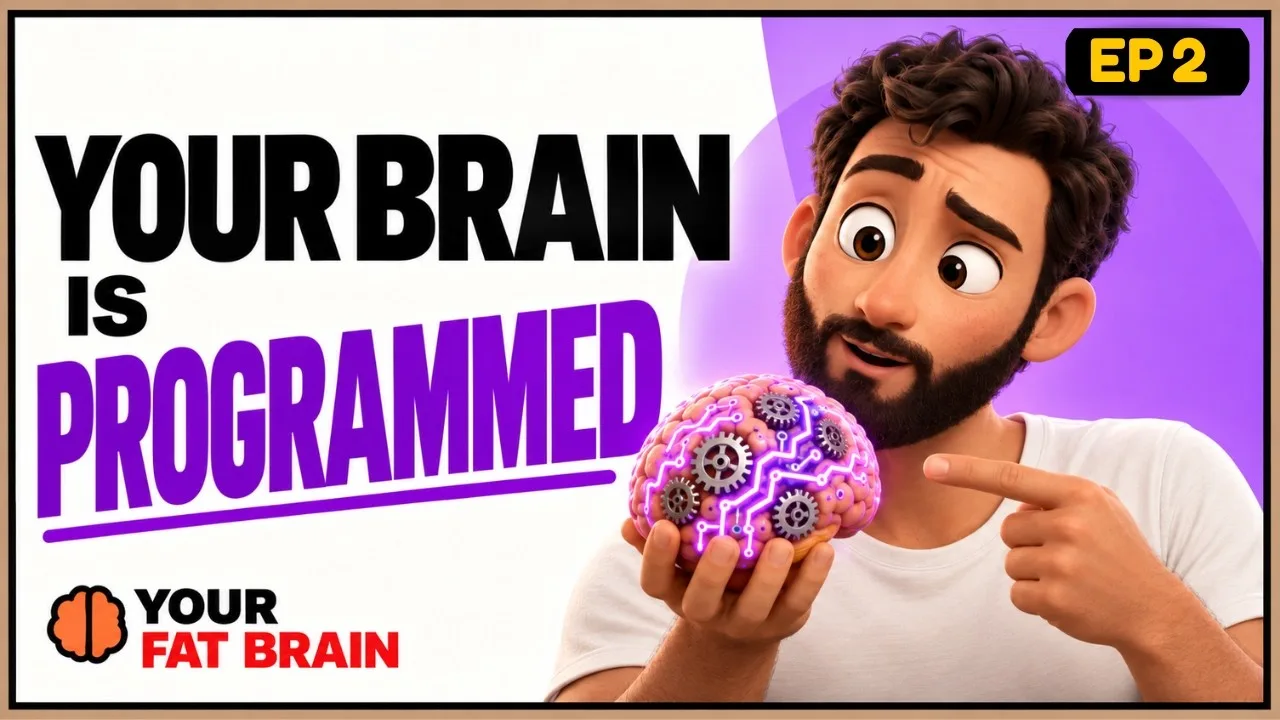
A “fat brain” is a brain that has been programmed to drive weight gain. Years of repeated habits wire food to comfort, stress and reward. Then three biological mechanisms (leptin resistance, dopamine dysregulation and chronic cortisol) lock that weight in place. That is why changing your diet alone was never going to be enough.
What if every single pound of excess weight you're carrying right now started as a thought? A memory. A habit loop. A chemical signal, happening silently inside your brain?
Because that's exactly what the science shows.
Your body didn't decide to be overweight. Your brain did. More specifically, your brain was programmed to be overweight. Step by step. Year by year. Often without you ever realizing it was happening.
Below, I'll show you exactly how that programming was built. The moment you see it clearly, you'll understand why changing your diet was never going to be enough.
How does the brain get programmed for weight gain?
Your brain is made up of roughly 86 billion neurons: nerve cells that communicate with each other through electrical and chemical signals. Every thought you have, every emotion you feel, every habit you repeat runs through networks of these neurons.
Neurons that fire together, wire together
One rule governs all of it, and it's one of the most important phrases in all of neuroscience:
Neurons that fire together, wire together.
Every time two neurons activate at the same time, the connection between them gets slightly stronger. Do the same thing repeatedly (the same thought, the same behavior, the same emotional response) and over time that connection becomes a thick, heavily insulated neural highway.
It becomes automatic. Effortless. Default.
This is how all habits form. It's also how your fat brain gets built.
How early food memories built the first pathways
Think back to your earliest memories around food. For many people, food was not just fuel. It was comfort. It was reward. It was love. It was celebration. It was the thing you got when you were sad, or sick, or when you did something well.
- “You got an A? Let's get ice cream.”
- “You fell down? Here's a cookie.”
- “Big game tonight? We're ordering pizza.”
With every one of those moments, your brain was quietly building an association, connecting the emotion to the food. Stress fires. Food fires. Stress and food wire together. (If this feels familiar, read how childhood experiences shape your eating habits.)
Fast forward to adulthood, and that neural highway is so wide, so smooth, so deeply grooved that the moment stress shows up, your brain doesn't pause and think. It already knows the answer. It fires down that road at full speed before your conscious mind even has a chance to intervene.
That is not weakness. That is neuroscience.
How adult habits keep reinforcing the program
It's not just childhood conditioning. Your fat brain gets continuously reinforced throughout your life:
- Every time you eat to manage boredom, that pathway gets stronger.
- Every time you reward yourself with food after a hard day, another layer of insulation wraps around that neural connection.
- Every time you zone out in front of the television with snacks, not because you're hungry but because it's what you do, the program runs again. And gets stronger.
Your brain is not judging you. It is learning from you. And for years, possibly decades, it has been learning one very consistent lesson:
Food solves problems. Food brings relief. More food equals more safety.
That lesson is now embedded in the architecture of your brain. And no salad and no treadmill has ever been designed to rewrite architecture.
But the food-emotion wiring is just one layer of the fat brain program. The deeper layer, the one most people never hear about, is what your brain does at a hormonal and neurological level to actively protect the weight you've accumulated.
What locks the fat brain in place?
Once the fat brain program is running (the neural pathways grooved, the habits set, the emotional associations wired), your brain does something extraordinary. It starts defending that state.
It begins operating as though your current weight is the correct weight. The safe weight. The weight it needs to protect. It does this through three distinct biological mechanisms that work in concert, like three locks on the same door.
| Lock | What goes wrong | How it keeps the weight on |
|---|---|---|
| Leptin resistance | Your brain stops hearing the “I'm full” signal from fat cells | You stay hungry, and your metabolism slows to conserve energy |
| Dopamine dysregulation | Processed foods overstimulate your reward system, so it turns down its sensitivity | Natural foods feel bland, and cravings take over |
| Chronic cortisol | Constant low-level stress keeps your stress hormone high | You crave calorie-dense food, store belly fat and lose impulse control |
Lock 1: Leptin resistance
Your fat cells produce a hormone called leptin. Leptin's job is to travel to your brain and say: “Hey, we have enough energy stored. You're full. You can stop eating.”
In a healthy, well-regulated brain, this system works beautifully. You eat, fat cells release leptin, your brain gets the signal, you feel satisfied, you stop.
Here's what happens in a fat brain. When you've been carrying excess weight for an extended period, particularly on a diet high in processed foods and refined sugars, your brain's leptin receptors become overwhelmed. They've been flooded with leptin signals for so long that they start to tune out. This is called leptin resistance.
The result is devastating. Your fat cells are screaming “FULL!” at maximum volume, but your brain has essentially gone deaf to the signal. So you keep feeling hungry. You keep eating. Not because of a lack of discipline, but because your brain's satiety signaling system has been chemically disrupted.
And it gets worse. Because your brain can't hear the “full” signal, it concludes you must be starving. So it:
- slows your metabolism to conserve energy,
- increases your drive to seek food, and
- makes high-calorie options more appealing.
All while you're sitting there, genuinely trying, feeling like you're failing for no reason.
Lock 2: Dopamine dysregulation
Dopamine is your brain's primary reward and motivation chemical. When something gives you pleasure or relief, dopamine is released. It creates the feeling of satisfaction and drives you to repeat the behavior.
This is a completely healthy system, until food hacks it.
Highly processed foods, engineered to be perfectly salty, sweet and fatty all at once, trigger dopamine releases dramatically higher than anything found in nature. We're talking about dopamine spikes that rival the responses seen with addictive substances. Your brain notices. It does what it's designed to do: it learns, and it encodes the lesson that food equals extraordinary reward.
But here's the cruel twist. Every time you flood your brain with those extreme dopamine spikes, your brain quietly reduces the number of dopamine receptors available. It downregulates (turns down the sensitivity) to protect itself from overstimulation. This is called dopamine tolerance.
The result? Natural foods like vegetables, fruits and lean proteins start to feel genuinely bland and unsatisfying. Not because they are, but because your reward system has been recalibrated to expect a much larger hit than nature provides.
Once your dopamine system is dysregulated, eating healthily doesn't just feel like a sacrifice. It feels neurologically unrewarding. Your brain isn't getting what it's been trained to expect, so it creates cravings: obsessive thoughts about specific foods, and compulsive urges that feel completely out of proportion to actual hunger.
This is not a character flaw. This is your dopamine system doing exactly what it was conditioned to do.
Lock 3: Chronic cortisol
Cortisol is your body's primary stress hormone. In short bursts (a genuine emergency, a physical threat, an acute stressor) cortisol is enormously useful. It sharpens your focus, mobilizes energy and prepares your body to act.
But modern life doesn't give most people short bursts of stress. It gives them a low, constant, unrelenting drip of it: work pressure, financial worry, relationship tension, information overload, social comparison. The stress never fully turns off.
Chronically elevated cortisol does three specific things that deepen fat brain programming:
- It directly stimulates appetite, especially for high-calorie, high-fat, high-sugar foods. Cortisol tells your brain: “We're in danger. We need energy. Eat the most calorie-dense thing you can find.”
- It promotes fat storage in the abdominal region, the most metabolically dangerous type of fat and the one most closely linked to insulin resistance, inflammation and cardiovascular disease.
- It physically degrades the prefrontal cortex. This is the one almost nobody talks about. Remember the prefrontal cortex from Episode 1? Your impulse control center, your decision-making brain? Chronic stress literally shrinks it over time, making you structurally less capable of resisting cravings and more prone to impulsive eating.
Stress doesn't just make you want to eat more. It biologically dismantles your ability to say no.
Why willpower alone will never be enough
Leptin resistance, dopamine dysregulation and chronic cortisol don't operate independently. They reinforce each other. They create a closed loop that keeps the fat brain program running even when you desperately want to stop it.
You are not fighting your habits. You are fighting a triply reinforced neurological operating system that your own biology has built around you.
Why do failed diets make the fat brain stronger?
Here's the thing that took me a long time to wrap my head around, and it's probably the most important point in this entire article. Every time you've tried a diet and failed, that failure didn't reset the system back to zero. It may have actually made the programming deeper.
Dieting triggers your brain's famine protocols
When you go on a restrictive diet, your brain interprets the drop in calories as a signal that food has become scarce. It activates famine protocols that have been hardwired into human biology for hundreds of thousands of years:
- Metabolism drops.
- Fat storage enzymes become more active.
- Hunger hormones escalate.
- Cravings intensify.
- The hypothalamus recalibrates its set point slightly upward as a buffer against future scarcity.
So when you inevitably break the diet (because you are fighting neuroscience, not character), your body doesn't just return to its previous weight. It often overshoots. It stores a little extra, just in case.
That's the science behind yo-yo dieting. And it means decades of repeated diet attempts have often left people in a neurologically worse position than if they'd never dieted at all.
Every relapse teaches your brain a lesson
It goes deeper than the hormones. Every time you attempt a diet and experience restriction followed by relapse, your brain encodes another lesson: deprivation leads to failure and suffering, and food brings relief.
That emotional loop (deprivation equals pain, food equals relief) gets carved into your neural architecture with every cycle. It tightens the grip of the fat brain program. It deepens the pathways. It makes the next attempt even harder.
This is not your fault. But it is your reality. And you cannot solve it by trying harder at the same strategy that has been reinforcing the problem all along.
What is required is not more discipline. What is required is a fundamentally different approach, one that addresses the brain's programming directly, before anything else.
Not a new diet. A new brain.
And the extraordinary truth, the thing that changes everything, is that this is genuinely possible. Because of neuroplasticity. Your brain's programming, no matter how long it has been running and no matter how deeply grooved it has become, is not permanent.
How do you start reprogramming a fat brain?
To begin unwinding fat brain programming, your approach needs to work on the same three levels where the programming was built.
| Level | What it targets | Tools |
|---|---|---|
| Neurological | Old neural pathways and the prefrontal cortex | Mindfulness, meditation, intentional behavior change |
| Hormonal | Cortisol, leptin, sleep hormones and dopamine | Sleep quality, stress architecture, meal timing and composition, supportive movement |
| Psychological | The emotional programs behind your eating | Awareness of triggers, then new and healthier response patterns |
Level 1: Neurological
You need practices that physically create new neural connections while letting the old, harmful ones weaken through disuse. Mindfulness, meditation and intentional behavior change are not soft suggestions. They are neurological tools. They create measurable, visible changes on brain scans. They rebuild the prefrontal cortex. They restore dopamine sensitivity. This series will show you exactly how to use them.
Level 2: Hormonal
You need to address the chemical environment your brain is operating in. Chronic cortisol, leptin resistance, disrupted sleep hormones and dysregulated dopamine are not fixed by eating salads. They are addressed through specific, targeted interventions: in sleep quality, in stress architecture, in the timing and composition of what you eat, and in movement practices that actually support hormonal recovery rather than creating more stress.
Level 3: Psychological
You need to understand and rewire the emotional programs that drive your relationship with food. Not by suppressing them. Not by fighting them. But by bringing them into awareness and systematically replacing them with new, healthier response patterns. This is the layer almost every weight loss program completely ignores, and it is arguably the most important of all. (See how the mind-body connection shapes weight loss.)
Over the coming weeks and months, the Your Fat Brain series will address all three levels in depth, with practical tools you can apply immediately.
This article is the map. The episodes ahead are the journey.
For a closer look at the science, read Why Your Brain Resists Weight Loss — and How to Work With It. For practical tools you can start this week, read 7 Practical Tools to Change Eating Habits Without Relying on Willpower.
You didn't grow a fat body. You grew a fat brain.
Here's the reframe I want you to sit with this week.
You have not been failing at weight loss because you are weak, undisciplined or broken.
You have been running a program. A program built over years by biology, by experience, by emotion, by chemistry. A program your brain learned, faithfully and diligently, because that is what brains do.
The fat brain isn't a character flaw. It is a learned operating system. And every single mechanism that built it (the neural pathways, the hormonal environment, the emotional conditioning) is reversible.
Nobody ever handed you the manual. Nobody ever showed you the source code. Nobody ever told you that the reason your diets kept failing was that you were trying to fix the output without ever touching the program.
Bodies are hard to control. But brains? Brains can be reprogrammed. From the inside out. Starting now.
Frequently asked questions
What does “neurons that fire together, wire together” mean?
Every time two neurons activate at the same time, the connection between them gets slightly stronger. Repeat the same thought, behavior or emotional response often enough and it becomes automatic, including reaching for food the moment stress shows up.
Why does healthy food taste bland when I try to eat better?
Highly processed foods trigger dopamine spikes far higher than anything found in nature, so your brain turns down its dopamine receptors to protect itself. Vegetables, fruit and lean protein then feel unrewarding, because your reward system now expects a much bigger hit.
Does stress cause belly fat?
Chronically elevated cortisol promotes fat storage specifically in the abdominal region and pushes your appetite toward high-calorie, high-fat, high-sugar foods. Over time it also wears down the prefrontal cortex, the part of your brain that helps you resist cravings.
Can a fat brain be reversed?
Yes. Because of neuroplasticity, every mechanism that built the fat brain (the neural pathways, the hormonal environment and the emotional conditioning) is reversible when you change the brain's programming instead of only your diet.