Easy Guide to Nutrition Labels for Best Choices
Navigating a grocery store can feel like a psychological battle against marketing buzzwords like “clean” or “natural”. To truly master your weight mindset, you must look past the front of the box and master the “Nutrition Facts” panel. This Guide to Nutrition Labels simplifies the process into a strategic habit that supports healthy weight management.
Using the Guide to Nutrition Labels: 4 Simple Steps
Step 1: The Serving Size Trap
The first thing to check is the serving size. This is not a recommendation of how much you should eat; it is simply the portion all the other numbers on the label refer to. If a bag of chips lists a serving as 10 chips but you eat 20, you must double every calorie, gram of fat, and milligram of sodium. Ignoring this “math” is a primary driver of passive eating.
Step 2: Decoding Calories and Energy
Calories provide a measure of the energy you get from a serving. While the average person needs roughly 2,000 calories a day, your specific needs vary based on age, height, and activity level. For healthy weight management, balance the energy you consume with what your body uses.
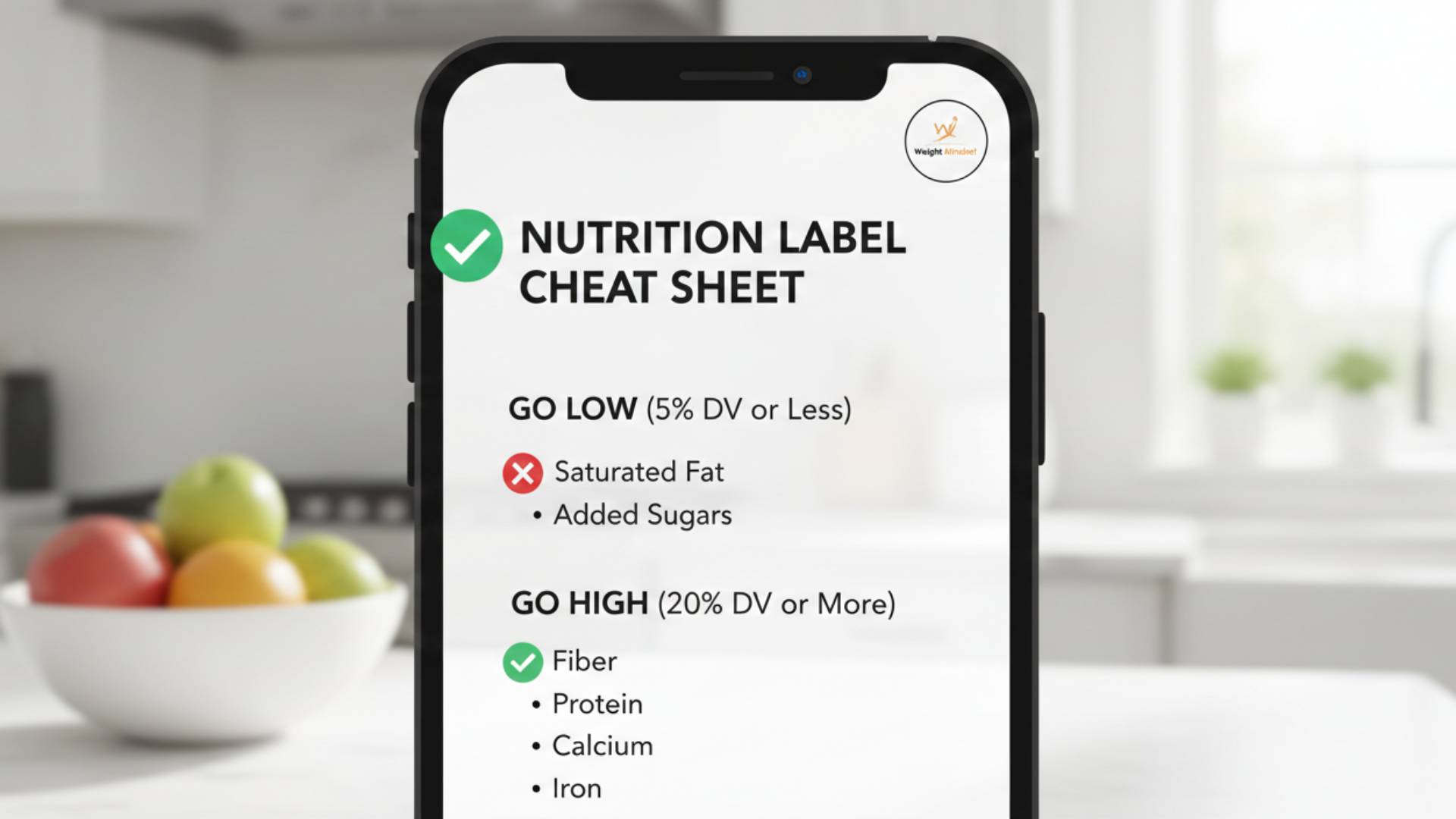
Step 3: The 5/20 Rule for Nutrients
The Percent Daily Value (%DV) is your quickest tool for comparing products:
- 5% DV or less means the food is low in that nutrient. Use this for things you want less of saturated fat, sodium, and added sugars.
- 20% DV or more means the food is high in that nutrient. Aim for this when looking for beneficial nutrients like fiber, Vitamin D, calcium, and iron.
Step 4: Watching for Hidden Ingredients
The ingredient list tells the deeper truth. Ingredients are listed by weight from highest to lowest. If sugar, refined flour, or industrial oils are in the first three ingredients, the product is likely highly processed.
Focus on Fiber (aim for 3–5g per serving) to promote fullness and Protein (aim for 5g or more) to support satiety and muscle health. By choosing whole, recognizable ingredients over long lists of chemical stabilizers, you support a cleaner, more resilient gut health.
Summary
| Step | Focus Area | Key Mindset Tip |
| 1. Serving Size | Check the portion first. | If you eat more than the listed serving, you must double or triple all the other numbers (calories, fats, etc.) to avoid passive eating. |
| 2. Calories | Energy per serving. | Balance the energy you eat with what your body actually uses based on your specific age and activity level. |
| 3. The 5/20 Rule | % Daily Value (%DV). | Go Low (5% or less): Saturated fat, sodium, and added sugars. Go High (20% or more): Fiber, protein, Vitamin D, and calcium. |
| 4. Ingredients | The “Deeper Truth”. | Ingredients are listed by weight. Avoid products where sugar or refined oils are in the top three; aim for at least 5g of Protein and 3–5g of Fiber. |
To truly master your weight mindset, your strategy should begin at the grocery store entrance by prioritizing the perimeter, where nutrient-dense whole foods like fresh produce, lean proteins, and dairy are located. While labels are essential for packaged goods, the healthiest choices—such as colorful seasonal vegetables, fruits, and fresh fish—often lack a label entirely. When you must venture into the center aisles for convenience, use your new skills to perform “food swaps,” such as choosing whole grains like quinoa or brown rice over refined white options to increase fiber and satiety. By focusing on foods with minimal, recognizable ingredients and avoiding those where sugar or unhealthy fats appear in the top three, you simplify your decision-making. This proactive approach reduces the psychological burden of constant label-checking, making healthy weight management a sustainable, natural part of your daily rhythm.